
Wednesday, May 13, 2009
Customer Service is User Experience
A political campaign, a not-for-profit, a business. They all have something in common: A movement.
Does the political campaign have volunteers or followers?
Does the not-for-profit have donors or community members?
Does the business have customers or fans?
In the future, change will be made by movements, not by pushing products or ideas.
How does that change customer service? Maybe customer service should be reinvented within the "user experience design" ubrella. To build a strong following, a large membership, or devoted fans we need to deliver an experience.
In the economy of the future, experience = value.
There are too many organizations out there that are going to fail simply because they do not recognize the move from marketing and customer service to user experience design.
Can you remember the last time you told a friend about a good product? How about the last time you told a friend about a great experience with an organization? See the difference?
Gentle Giant Moving Company gets it.
Zappos gets it.
"Zappos does not have specific policies for dealing with each customer service situation. He (the CEO, Tony Hsieh) claims that the company's culture allows it to do extraordinary things. I saw him make this point earlier this year in New York City, when he told a story about a woman whose husband died in a car accident after she had ordered boots for him from Zappos. The day after she called to ask for help with the return, she received a flower delivery. The call center rep had ordered the flowers without checking with a supervisor and billed them to the company. "At the funeral, the widow told her friends and family about the experience," Hsieh said, his voice cracking and his eyes tearing up ever so slightly. "Not only was she a customer for life, but so were those 30 or 40 people at the funeral.""
Inc Magazine article.
Seth Godin gets it.
Blog Post
Video
Microsoft does not get it.
The Fireworks Project will be built to deliver a great experience to everyone that touches it.

Thursday, May 7, 2009
The Challenge of Open Design
Open design is getting a bunch of people together, often without any face to face contact, and designing something that everyone in the World will love. This is hard to do with a closed design process, and even harder to do with an open design process.
So why do it? I believe, as do many other people, that open design holds far more potential than closed design because of the larger talent pool that can take part in the process. The problem is that this is a young discipline, and there is still a lot we don't know about it. Because of it's immature status, open design often ends in failure, and many of the participants concede that it cannot work.
But, open design can survive and thrive if we are persistent and continue to document the lessons of our failures as well as success.
So, to kick off design within the Fireworks Project, I thought I would start by outlining a theory of how the open design process might work, using another blog post by Aza Raskin as a jumping off point. Aza is the lead on user experience with Mozilla Labs, among many many other things. One of the latest projects he is working on is Ubiquity, which used an open design process to create the latest logo. Aza was gracious enough to document the lessons they learned from the process, giving us a leg up to begin our own experimentation.
With the Fireworks Project, we also have the perfect opportunity to try out open design with our own logo creation process.
The objective is to create a great logo, but also to reach a state of design thinking through the process of design.
This is my vision of the process:
Focus
What is the design objective and what are the constraints? Identifying what the project is not rather than what it is can be a helpful exercise at this point. A clear focus for the project will provide a visible rubric for judging our work as we move through the design process.
Lead
Designate a leader for the project that will facilitate discussion, incorporate feedback, and keep the iterations moving. A good leader will ask focused, concrete questions that get focused, concrete feedback.
Iterate
The design process will need to iterate many times to get a good result in the end. Each iteration is a three step process:
1. Expand the idea into as many corners of our creative minds as we can. Open design projects will be particularly good at that.
2. Revise and "sketch" out most of the ideas. Sketch is defined in this context as anything that acts as an aide to our thought processes, not necessarily the common pencil and paper.
3. Narrow the body of work with a structured critique process. This step relies heavily on the Focus part of the design. What are we trying to achieve, what are our constraints, and what are we not trying to do?
We need to plan for many iterations and accept that the process will take some time. We cannot cut the process off prematurely because we become impatient.
Communicate Effective communication is constant communication. Use every tool available. Blog about ideas, use Twitter, instant chat, and news groups.
Wait
Ideas need time to sink in, and inspiration never seems to strike whenever we snap our fingers. Leave the project behind, move on with life, and then get back to it with a fresh mind for the next iteration.
I tried to sum this theory up with a diagram inspired by Sketching User Experiences.
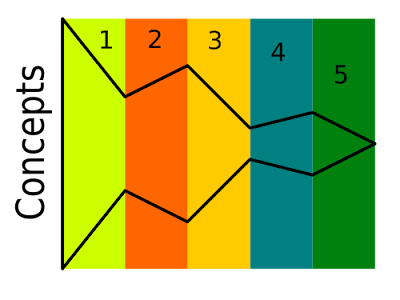 Concepts are fed into the process on the left, and emerge in a refined state on the right. Each vertical bar in the diagram represents an iteration of the design process. This diagram has 5 iterations, but there could be more or less, depending on what it takes to reach the desired outcome outlined in the Focus. Also, some iterations explore additional possibilities while others refine ideas toward the Focus. This is represented by the black lines that end in a point on the right.
Follow along to see how well we do.
Concepts are fed into the process on the left, and emerge in a refined state on the right. Each vertical bar in the diagram represents an iteration of the design process. This diagram has 5 iterations, but there could be more or less, depending on what it takes to reach the desired outcome outlined in the Focus. Also, some iterations explore additional possibilities while others refine ideas toward the Focus. This is represented by the black lines that end in a point on the right.
Follow along to see how well we do.
 Concepts are fed into the process on the left, and emerge in a refined state on the right. Each vertical bar in the diagram represents an iteration of the design process. This diagram has 5 iterations, but there could be more or less, depending on what it takes to reach the desired outcome outlined in the Focus. Also, some iterations explore additional possibilities while others refine ideas toward the Focus. This is represented by the black lines that end in a point on the right.
Follow along to see how well we do.
Concepts are fed into the process on the left, and emerge in a refined state on the right. Each vertical bar in the diagram represents an iteration of the design process. This diagram has 5 iterations, but there could be more or less, depending on what it takes to reach the desired outcome outlined in the Focus. Also, some iterations explore additional possibilities while others refine ideas toward the Focus. This is represented by the black lines that end in a point on the right.
Follow along to see how well we do.
Friday, April 10, 2009
A More Thoughtful Voting Tool
The Chocolate Factory project out of Mozilla Labs has really captured my imagination lately. Open source design in software is obviously something I'm really passionate about, and something that has not been done very successfully yet. The Chocolate Factory is a bold experiment to bring some high level thinking in open source design down to earth. And that is really exciting!
One of the most important tools within this project will be the voting or rating system used to collaboratively advance the best projects through a development cycle. Because of the importance of this tool, and the lack of any good implementation examples out in the real world, it has been a little tricky to get right.
Yesterday, Pascal Finette, a lead on Chocolate Factory, came accross a new idea for voting that keeps it simple, gives good user feedback via the UI, and generates some meaningful data for number crunching on the back end.
I really liked it, but this morning I had another thought that extends it. There is really nothing very different about it, except by adding a chart as a backdrop, the UI presents a canvas for more meaningful feadback to the user.
 There would be a slider that followed the blue line when dragged by a mouse (or arrows for people like me who do not use a mouse). A horizontal or vertical drag would result in the same action of the slider along the blue line. The chart could be labeled with numbers on the x and y axis, and the stripes in the chart could represent various "human interpretations" of the project like "very incomplete", "confusing", "has potential", "will take over the world".
Maybe that will all be too complicated in the end, but even without it, I kinda like the chart. It helps me understand that as I move the slider, my extreme opinions will carry more wieght than my more moderate ones.
The whole point is to avoid pidgen holing the user, and the data, into a system like this:
http://www.babynamewizard.com/namipedia/boy/kris
( Feel free to push all the sliders on that page all the way to the right )
There would be a slider that followed the blue line when dragged by a mouse (or arrows for people like me who do not use a mouse). A horizontal or vertical drag would result in the same action of the slider along the blue line. The chart could be labeled with numbers on the x and y axis, and the stripes in the chart could represent various "human interpretations" of the project like "very incomplete", "confusing", "has potential", "will take over the world".
Maybe that will all be too complicated in the end, but even without it, I kinda like the chart. It helps me understand that as I move the slider, my extreme opinions will carry more wieght than my more moderate ones.
The whole point is to avoid pidgen holing the user, and the data, into a system like this:
http://www.babynamewizard.com/namipedia/boy/kris
( Feel free to push all the sliders on that page all the way to the right )
 There would be a slider that followed the blue line when dragged by a mouse (or arrows for people like me who do not use a mouse). A horizontal or vertical drag would result in the same action of the slider along the blue line. The chart could be labeled with numbers on the x and y axis, and the stripes in the chart could represent various "human interpretations" of the project like "very incomplete", "confusing", "has potential", "will take over the world".
Maybe that will all be too complicated in the end, but even without it, I kinda like the chart. It helps me understand that as I move the slider, my extreme opinions will carry more wieght than my more moderate ones.
The whole point is to avoid pidgen holing the user, and the data, into a system like this:
http://www.babynamewizard.com/namipedia/boy/kris
( Feel free to push all the sliders on that page all the way to the right )
There would be a slider that followed the blue line when dragged by a mouse (or arrows for people like me who do not use a mouse). A horizontal or vertical drag would result in the same action of the slider along the blue line. The chart could be labeled with numbers on the x and y axis, and the stripes in the chart could represent various "human interpretations" of the project like "very incomplete", "confusing", "has potential", "will take over the world".
Maybe that will all be too complicated in the end, but even without it, I kinda like the chart. It helps me understand that as I move the slider, my extreme opinions will carry more wieght than my more moderate ones.
The whole point is to avoid pidgen holing the user, and the data, into a system like this:
http://www.babynamewizard.com/namipedia/boy/kris
( Feel free to push all the sliders on that page all the way to the right )
Subscribe to:
Posts (Atom)